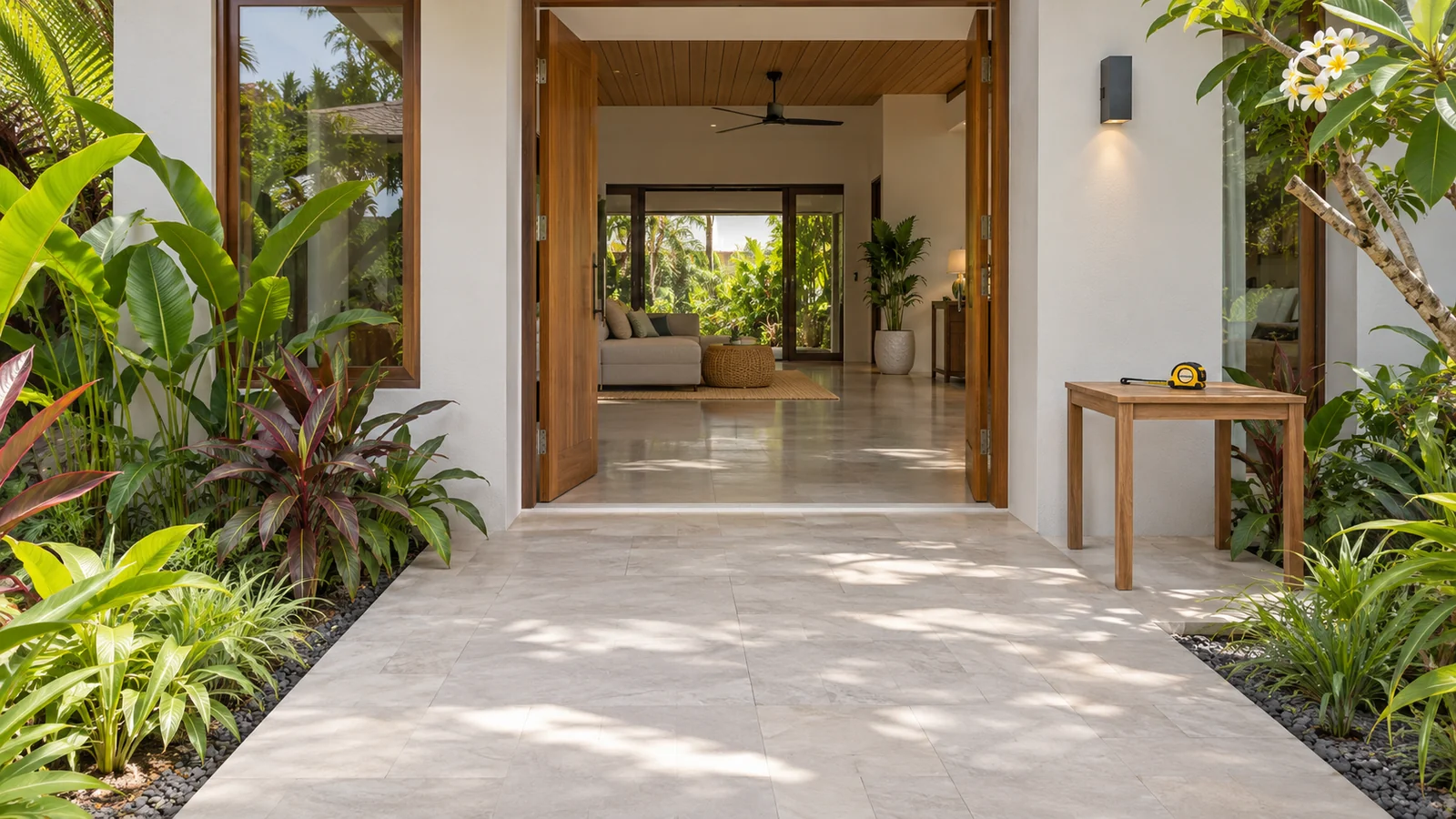
A ground-floor bedroom does not answer every access question about a villa. The route may include a gate, driveway, entrance threshold, narrow turn or bathroom doorway before a guest reaches that room. Start with the person’s actual requirements, then ask for current evidence covering the complete route through the property.
This is a practical booking checklist, not an accessibility certification or a promise that a particular villa will suit a guest. The bedrooms and capacity guide helps allocate rooms; access needs a separate, more detailed check before you choose them.
Write a functional brief rather than a diagnosis
Describe the parts of the stay that need to work: getting from the vehicle to the entrance, reaching a bedroom and bathroom, moving between the areas the guest intends to use, and leaving again. If equipment is involved, provide its relevant dimensions and turning needs with the guest’s agreement. Medical history is not needed to ask for doorway measurements.
Be specific about which steps or transfers are workable for the individual and which are not. Avoid relying on broad labels such as “easy access” or “senior friendly.” Those phrases can mean different things to different people. Ask the guest which details are essential before the property contact starts proposing alternatives.
Trace the approach from the actual arrival point
Ask for a continuous sequence of current photographs or a short walkthrough from the agreed vehicle drop-off to the entrance. Include gates, changes in surface, slopes, thresholds and doors. A close-up of a flat doorway is incomplete if the route to it contains a step that has not been shown.
Check the arrival arrangements too. Where can the vehicle stop, where will bags be placed, and will the route remain clear while the group unloads? If the normal entrance is unsuitable, ask whether a proposed alternative is genuinely available to guests throughout the stay. A convenient route during a supervised visit may not be the route you can use independently later.
Ask for measurements that answer a specific question
Airbnb’s accessibility-feature guidance illustrates the value of photographs showing the whole approach, open doorways and measured features. It is a platform example, not a statement that a Pugachev property is listed there or meets that platform’s criteria. For your booking, ask for the actual measurements your guest needs to evaluate.
| Part of the route | Evidence to request | Question it resolves |
|---|---|---|
| Arrival to entrance | Continuous photos of the approach | Are there unshown steps or obstacles? |
| Entrance | Open-door photo and clear-width measurement | Can the required equipment pass? |
| Bedroom route | Doorways, turns and level changes | Can the assigned room be reached? |
| Bathroom | Entrance and usable space around fixtures | Does the layout meet the guest’s needs? |
| Outdoor area | Route from the house to the desired space | Is that amenity practically reachable? |
| Alternative access | Availability and operating instructions | Can it be used during the whole stay? |
Evaluate the bedroom and bathroom together
Confirm the intended room rather than assuming any ground-floor bedroom will work. Ask about the route between the bed and bathroom, usable space around the furniture, and any doorway or threshold along that route. A wide entrance does not settle the room’s internal layout.
Have the guest review the information before the room is assigned. If a particular feature or item of equipment is essential, ask whether it actually exists and obtain current photographs. Do not substitute improvised equipment or assume that decorative rails, furniture or a general shower photograph proves suitability. Where specialist advice is needed, let the guest involve the appropriate professional rather than asking the booking team to make that judgement.
Check every amenity you expect to use
An accessible route to the house does not establish access to a terrace, pool, garden or upper floor. Identify which areas matter and check each route separately. If a lift or other equipment is proposed, confirm its availability, dimensions, operating arrangements and contact for problems instead of relying on its appearance in a gallery.
Connect the property brief with transport. The vehicle-entry checklist addresses getting into the actual car; it does not guarantee access at the destination. Ask each provider to confirm their own part of the journey so a workable vehicle does not end at an unsuitable entrance.
Keep unresolved requirements visible
Create a short list with three states: confirmed with evidence, awaiting information, and unsuitable for the guest’s stated need. Share only the relevant details with the responsible property contact. Do not convert a missing measurement into an optimistic assumption just because other features look promising.
Send your property reference and access brief to property@pugachev.miami. Ask the guest to review the final evidence and written arrangements before committing. If the essential route cannot be verified, keep looking for a suitable proposal rather than treating a general accessibility label as a complete answer.