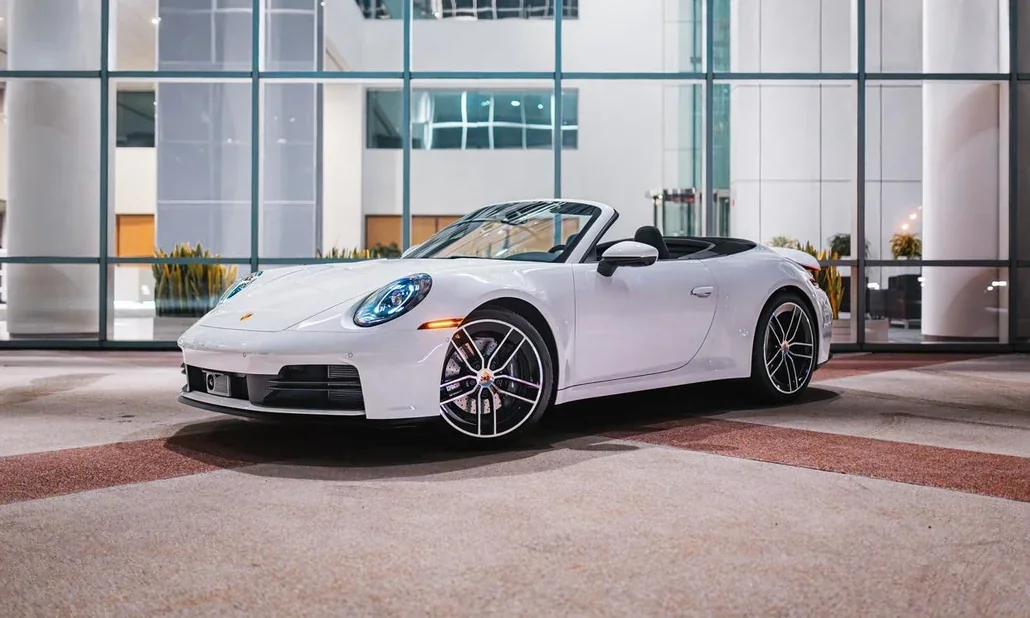
For a two-person Miami trip, the Porsche 911 Carrera Cabriolet and Mercedes-Benz SL offer two different interpretations of a soft-top sports car. The useful starting point is their engineering: the listed white 911 has a twin-turbo flat-six and an eight-speed PDK transmission; the listed white SL has a twin-turbo V8 and a nine-speed AMG MCT transmission. Neither specification tells you whether your rear passenger or largest suitcase will fit.
Choose the 911 if experiencing Porsche's rear-engined sports-car layout is central to the trip. Shortlist the SL if the V8 roadster is the experience you want. Before either becomes a booking, resolve the small rear seats, luggage arrangement and roof operation for the specific car. Here is how to make that comparison without confusing a manufacturer's entire range with the car you are requesting.
Compare the two actual cars
Start with the current white Porsche 911 Carrera Cabriolet and white Mercedes-Benz SL pages. These are the examples behind this guide. Their galleries and current published rates are more useful than specifications for a different year or trim found in a general search.
| Detail | Listed Porsche 911 Carrera Cabriolet | Listed white Mercedes-Benz SL |
|---|---|---|
| Engine on the vehicle page | 3.0-litre twin-turbo flat-six | 4.0-litre twin-turbo V8 |
| Transmission on the vehicle page | Eight-speed PDK | Nine-speed AMG MCT |
| Passenger planning | Four seats described as 2+2 | Four listed seats; this SL generation uses 2+2 seating |
| Roof | Convertible; confirm the exact operating procedure | Convertible; confirm the exact operating procedure |
| First booking check | Rear-seat need and luggage arrangement | Rear-seat need and luggage arrangement |
Both listings remain subject to confirmation for your dates. Do not use this table to infer a particular optional chassis system, wind deflector, audio package or driver-assistance feature. Those require confirmation on the vehicle supplied.
Understand the layout before choosing by horsepower
The 911's engine is behind the passenger compartment. Porsche's Carrera and Carrera Cabriolet specifications document that rear-engine architecture. Its front luggage compartment is a practical consequence to consider when you bring rigid cases: the usable opening and shape matter more than a headline volume.
The Mercedes offers a different engine and transmission pairing in the listed car. That is a meaningful choice for someone specifically seeking a V8 roadster, but it is not evidence that the SL will be more comfortable on your route or faster in ordinary Miami traffic. This comparison is based on documented specifications and trip planning, rather than a back-to-back road test. Choose the mechanical character you want, then check the cabin and loading arrangement.
Treat both cars as 2+2, not four equal seats
Mercedes describes the modern SL's arrangement as 2+2 in its SL Roadster reference guide. The Porsche listing also explicitly says 2+2. That distinction matters: a four-seat label alone is insufficient for planning regular journeys with four adults.
If a rear passenger is essential, provide their needs before committing and ask to assess the actual seating position behind the intended driver. Front-seat position changes the space remaining behind it. For child restraints, request vehicle-specific compatibility guidance rather than assuming that a rear seat automatically accepts your restraint. If four adults must travel together repeatedly, compare an appropriate four-door alternative instead of forcing either roadster to solve the wrong problem.
Load for the journey with the roof in use
Two people spending an afternoon around Miami Beach have a different luggage problem from two people arriving with several hard cases. List every item that must travel at the same time, including cabin bags. Ask for a loading assessment with the roof in the configuration you intend to use and with any required mechanism clearance respected.
Do not assume bags can simply be moved onto an unused rear seat: loose belongings must be secured, and access, visibility and safe operation still matter. If the arrival load is the only obstacle, consider getting luggage to the hotel separately before collecting the convertible. That separates an airport transport requirement from the open-top experience you actually want.
Make the handover specific to the roof and controls
Ask the team to demonstrate opening, closing and fully securing the roof on the actual car. Confirm what must stay clear and how the car indicates that the operation has finished. Follow the supplied vehicle's manual and handover instructions; an operating limit quoted for another model year is not a shortcut.
Also locate the parking-brake control, transmission selector, fuel-filler release and luggage-compartment release before leaving. Familiarity with a different Porsche or Mercedes does not establish familiarity with this example. A short, stationary walkthrough is more useful than discovering unfamiliar controls at a busy hotel entrance.
Choose a winner for your itinerary
For a couple travelling light who specifically want a 911, the Carrera Cabriolet is the natural first request. For a couple seeking the listed V8 Mercedes roadster, start with the SL. Where the trip depends on rear-seat use or substantial luggage, let a verified fit assessment override either initial preference.
Request comparable proposals using identical dates, collection and return times, locations and anticipated mileage. Review the full rental total and deposit separately, with any delivery and extra-mile terms confirmed. For another genuine convertible choice, see our Ferrari Portofino versus Porsche 911 Cabriolet guide. Keep this shortlist to the cars you would actually enjoy with the roof closed as well as open.